jueves, 2 de agosto de 2012

Traditional games

Level: 2nd grade
Subject: Traditional & Modern games
Objectives:
Students will be able to practice pronunciation for traditional and modern games through play

Procedures:
Mimic game
·         The group is divided in 2 and they select a name for their team.
·         2-3 students are called by the teacher to represent a traditional game with a corresponding card; students cannot talk nor do gestures to respond to their partners while they are guessing
·         If the response is in Spanish the point doesn`t count
·         After some rounds the students called to the front can choose another game that is not in the book.
The team with more points win


Action Cards for: Eyes closed, opposite hand, mimic, simple draw, wild card.


 Vocabulary:
Hide and seek
Telephone
Freeze Tag
Ride bikes
Yo-yos
Marbles
Jump the rope
Others

Translation in the classroom

I have  seen the need of transalation when working with children that are just starting to learn English as a L2 so I am wondering until what point should we do it?, is it right? how to do it? Here is an article about it that you can read it and right your input back:


EFL Teaching: Is There a Need For Translation When Teaching Vocabulary?


Is There a Need For Translation?

Translation into the student's native or first language is unnecessary in many cases when teaching English vocabulary to speakers of other languages. For many years traditional linguists have advocated translating all new vocabulary into the student's native language before he is ready to read or speak an unfamiliar passage. I will show in this hub that a complete reliance on translation is often not needed and detrimental to the student when learning English.


The Traditional Method of Teaching Vocabulary

If you pick up conversational or reading textbooks for EFL students in such countries as China, Japan, Korea, and Thailand, you will find conversations and readings followed by long lists of English words translated into Chinese, Japanese, Korean, and Thai. When the student begins a lesson, his teacher will first have the student say the new words once, and then pay attention to the meaning of the words in his native language. Following this, the student will go through the conversation or reading article while his teacher points out in the student's native language the meaning of the passage as well as grammatical patterns that the student must know.


This type of teaching method has been around a very long time, and it is called the grammar-translation method. Derived from the traditional method of teaching Greek and Latin in the West, this method aims to have students completely understand the grammatical rules and vocabulary of any foreign language. The method has been so popular around the world, because you don't need native speakers to teach foreign languages. It is also easy for the teacher to use. You only really need the student's native teacher who has a knowledge of the grammar of the foreign language being taught. The teacher is not using the foreign language for communication, because all explanations about the foreign language are in the student's native language.


How People Learn Vocabulary

When teaching vocabulary, the grammar-translation method fails because it goes against the natural way one learns his native or first language. When learning your first language, concrete vocabulary is acquired from mental images of what you see and experience from your other senses. For example, a toddler will see, hear, and feel water, and then hear the word "water" spoken by his mother or father.


When the child gets a little older, other abstract vocabulary is learned from associations. For example, the young child will acquire the meaning of "bad" by associations with actions such as not eating his food, hitting playmates, and not taking a nap which are not rewarded. Citing another example, the concept of "freedom" will be acquired by seeing animals both in and out of cages, and by viewing people who are and aren't wearing handcuffs.


When I began learning Chinese Mandarin, I was fortunate to have a native speaker who taught me using a direct method which is very similar to how you learn your first or native language. Mr. Chen expended great effort in explaining new vocabulary with pictures and actions which created mental images of the Chinese character being taught. All of his lesson sheets were more than 98 percent in Chinese characters. If he could not explain a new concrete or abstract character or word using a picture to create a mental image or association, he explained it with simpler synonym characters which were all student friendly. I learned how to think in Chinese, and it was extremely helpful to me in acquiring fluency in the language.


Disadvantages of Use of Translation When Teaching Vocabulary

The use of translation when teaching vocabulary has the following disadvantages:


1. It Goes Against The Natural Process of Acquiring Language:


As a child, one learns his native language by first acquiring listening and then speaking skills. Later, the child develops reading and then writing skills in school. In acquiring listening and speaking skills, the toddler is getting mental images for words from concrete experiences and associations. By giving translations of words, we are not giving the student mental images of words which the the student can internalize and later easily use in speech. We are also going against the natural process of acquiring language.


2. Interference From The Student's Native Language:


Interference from the student's native language usually results in mistakes in pronunciation, sentence word order, and other correct grammatical construction. The phonemes and phonetics of all languages are different from English. For example, the word for "gas" in Thai is similar to English; however, in Thai pronunciation the ending "s" sound is not pronounced. Word order in sentences also presents problems to the second language learner. In Thai, adjectives are placed after nouns instead of preceding nouns as in English. Too many times students will write sentences such as "I like playing game computer."


3. Translation Can't Capture The Exact Meaning:


Language is part of culture. Unless you learn a language and its vocabulary as it is experienced by native speakers, you will never be able to acquire the exact meaning of a word. On too many occasions, translation will fail in explaining the meaning of vocabulary, because the translator doesn't have a mental image or the correct images and associations for a word.


4. Translation Slows Down Learning And Doesn't Foster Thinking in a Second Language:


When one reads a newspaper or book, one doesn't look up every word that is unclear or unknown. If a person did this, there would not be that much reading. Reading would be a chore, very boring, and not very enjoyable. This, however, is exactly what we are doing when we require second language learners to learn and look up all the words they don't know. Instead, we should be teaching students strategies for learning new words through associations with past experiences. Doing this will go a long way in helping students to start thinking in a second language.


When Should Translation Be Used?


I am not advocating that translation should never be used when teaching vocabulary. It should be extremely limited and only used as a last resort when the teacher can't explain words with images or associations, and when the teacher is certain the translation is absolutely correct. Acquisition of vocabulary is extremely important when learning a language, and it must be learned by the natural process that one uses in learning his native language.


Source:

My interests

Level: 2nd grade
Subject: My interests
Objective: Students will be able to produce complete sentences to express preferences or interests


Procedures:
Confirm that content is clear by doing some questions and asking examples.
Play a race game by:
·         Divide the class in two teams
·         Write the four main phrases related to the topic in the board (My favorite/ I like to/ She likes to/ He likes to)
·         Bring a box with paper straws with activities and actions so that students pick one paper and do the match with the corresponding phrase. If correct 1 point, if incorrect 1 point for the other team.

Rules of the game:
  • The only person I choose from the group reads the final sentence
  • Teammates can help but quietly
  • Before I count until 5 all must be in their chairs
  • If noise of misbehave the point is automatically given to the other team.

Classroom objects

Level: 1st grade
Subject: Classroom objects
Objectives:
The students will be able to associate real objects with the respective word
The student will be able to practice pronunciation by repeating after the teacher


Procedure:
Teacher presents the vocabulary words with real objects. The teacher find a real object in the class and then write the word in the board followed by the corresponding drawing. Students must copy in their notebooks.
Reinforce pronunciation with the students; they must repeat after the teacher the 12 classroom objects written in the board.
Students have to circle and color the objects that we have in the class for the workbook activity.
Play memory game. The students that can remember the more objects win. They have to make the list in their minds and then share with the class


Vocabulary

Pencil
Pen
Eraser
Trash can
Desk
Chair
Book
Glue
Scissor
Chalk
Markers
board

Classroom Management

So far I have experienced the importance of an efficience classroom management. Here is an article where I found interesting suggestions for us:
Quick Tips to Help with Classroom Management
Ideas to Help with Classroom Discipline and Management


Keeping a classroom running smoothly is a day-to-day task for teachers. The purpose of this list is to provide teachers with ideas that they can begin to implement right away. Use this in conjunction with the top tips for successful classroom discipline to help create an effective and enjoyable learning environment in your class.

1. Write With Large Letters on the Board
While this might seem simplistic, the fact is that some students will have trouble seeing the board if you write in small letters on the board, or if you don't write dark enough. Don't give students any more excuse than normal for not participating. Something you can try is to write something on the board in your normal method, then go to the back of the room and see if you can read it. If you have trouble, some of you students will be having trouble too.

2. Speak Loudly
I once had a very sweet teacher who reverted every day to almost a whisper. This is not an ideal situation in that students will either lose focus quickly since they can't hear their teacher very clearly or they will start disrupting class. However, this does not mean you should shout. In fact, screamers are just as bad as whisperers in losing kids attention.

3. Learn Names and Use Them
Obviously, the sooner you learn names in the school year, the better. However, even after the beginning of school has long passed, you should still call students by their name. This keeps them focused and involved.
4. Write Your Agenda on the Board
Even if you just write headings, providing the students with information about what is going to be covered in class by writing an agenda on the board can help keep them focused. With this said, it is not a good idea to write the homework assignment on the board, as some students will be tempted to begin it instead of participating in the lesson.

5. Don't Race Through Lessons
Sometimes teachers have so much information to cover that they just race through lessons each day. However, this can be a mistake as it doesn't allow students of varying abilities the chance to keep up with the information being taught. It is important to ask questions while you are teaching to gauge students understanding. With this information, you can then choose to continue on or to slow down and cover material in greater depth. However, if you just speed through your lessons, you won't have this as an option.


6. Require Students to Raise Their Hands
Having students raise their hands is a very important classroom management skill. This requirement allows you to have the ability to call on different students instead of just allowing same few to always call out answers in the classroom. Further, it allows you to provide wait time to let students have the chance to think about your question, giving more students the opportunity to be involved.

7. Give Students Enough Time to Raise Their Hands
As mentioned previously, wait time is a very important concept. Obviously, if you are not having students raise their hands then you really can't use wait time. However, if you have students raise their hands, do not call on the first child that throws their hand in the air. Instead, wait five to seven seconds before calling on anyone. This will allow students to have the time to listen to, think about, and formulate an answer to any question you pose.
8. Ask Obvious Questions
You should ask questions to the class at all levels of Bloom's Taxonomy. However, some teachers fail to ask very simple questions, seeing them as obvious and unnecessary. However, they can serve a couple of purposes. First, they can get more students involved in answering questions since their answers are obvious. Second, they can provide you with quick feedback on what the students are learning. If what you think is obvious isn't so easy for the students, you need to relook at what you are teaching.


Source:
http://712educators.about.com/od/teachingstrategies/tp/Quick-Tips-To-Help-With-Classroom-Management.htm

Hobbies & Traditional games

Level: 3rd grade
Subject: Hobbies & Traditional games
Objective: Students will be able to understand the meaning and examples of hobbies
Procedure:
Engage students with the topic by asking what they do in their free time and providing clues to the subject.
Book activity. Students must colored and cut the drawings representing activities and then paste them in a park background according to corresponding places


This is the work done by one of my students

Clothes & Descriptions

Level: 2nd grade
Subject: Clothes & Descriptions
Procedure:
Students  color and cut the cloth pieces to dress up the children bodies. Descibe what each child is wearing
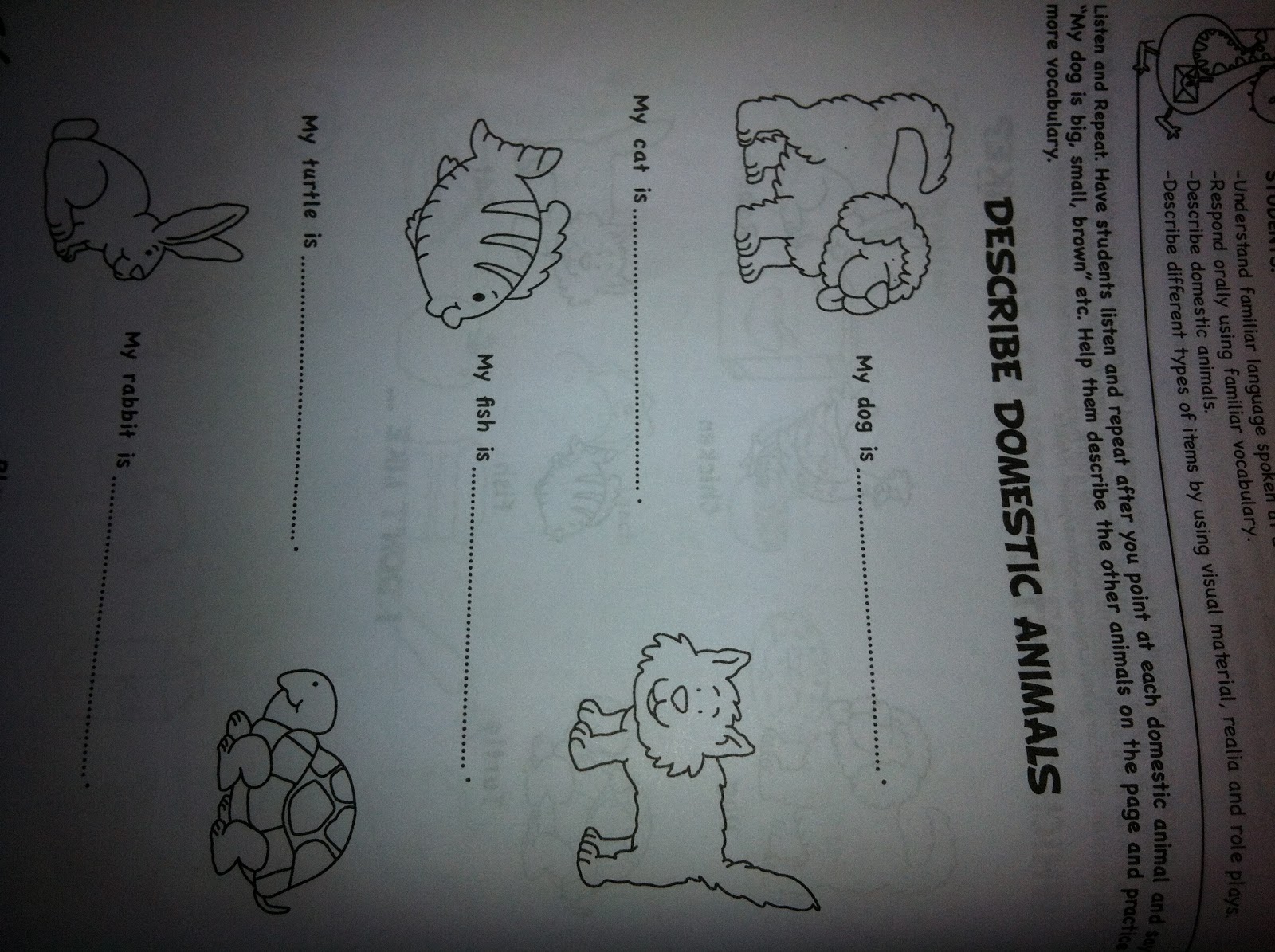
Fill in the blanks with adjectives for animals such as colorful, beautiful, hairy, etc to practice other adjectives